Huntington’s Field Architecture Report
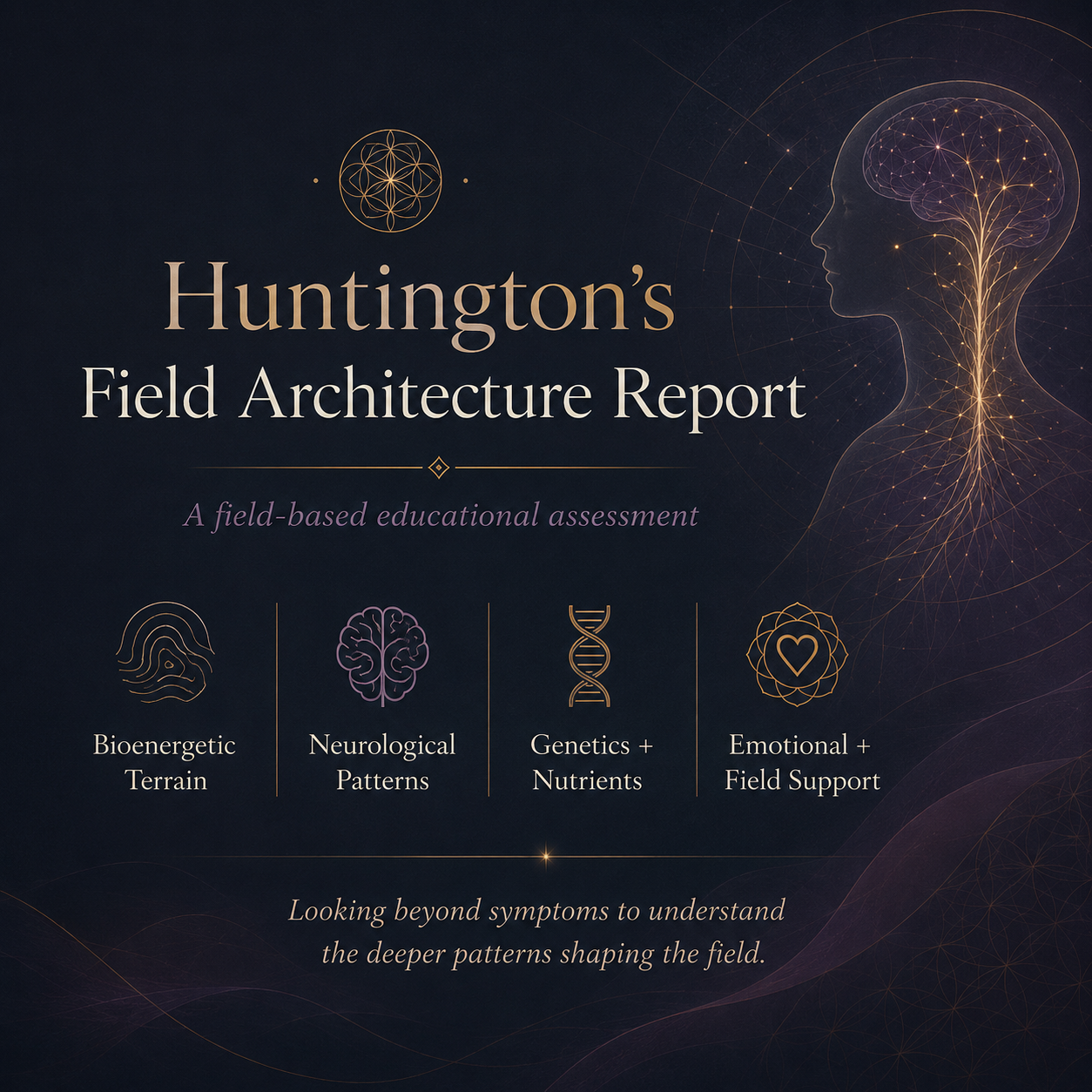
Huntington’s Field Architecture Report
The Huntington’s Field Architecture Report is a personalized, field-based educational assessment designed to look beyond symptoms and explore the deeper patterns that may be influencing neurological health, resilience, and overall terrain.
Rather than focusing on Huntington’s disease from a single perspective, this report examines the body as an interconnected system—looking at areas such as bioenergetic terrain, mitochondrial function, neurological patterns, genetics and SNP considerations, nutrient status, chronic stressors, emotional load, and nervous-system regulation.
The report may explore patterns related to:
Bioenergetic and mitochondrial stress
Brain and nervous-system coherence
Basal ganglia, cerebellar, and motor-system patterns
Genetic vulnerabilities and methylation considerations
Nutrient and mineral support
Chronic infection or co-infection considerations
Emotional and nervous-system patterns
Personalized Flamekey and field-support recommendations
Foundational next steps to discuss with your healthcare team
The intention is not to predict disease progression or replace neurological care. It is to provide a broader lens for understanding the person behind the diagnosis and help identify supportive areas that may otherwise be overlooked.
Who This Report Is For
This report may be helpful for someone who has been diagnosed with Huntington’s disease, has a family history of Huntington’s, or is looking for a more holistic way to understand the physical, neurological, emotional, and bioenergetic layers surrounding their experience.
The KQU Approach
At Kimbley Quantum University, we do not look at one symptom, one gene, or one scan in isolation. We look for patterns and relationships.
The goal is clarity: understanding what may need support first, where the greatest stress is showing up, and how to begin rebuilding the foundations in a more intentional order.
This is an educational, field-based report and is not a diagnosis, treatment plan, or substitute for medical care. Huntington’s disease requires appropriate evaluation and ongoing care from qualified medical professionals, including neurology.
Please allow 72 hours for your report to be emailed to you